I just finished scanning down through one of those subscription e-mails that magazines send out. You know the kind, where it's an e-mail with one paragraph from each of a dozen different articles.
Well this one was an interesting paragraph, it caught my eye immediately. It was written by a guy who will shortly graduate from an MBA programme. He's writing a blog for the magazine and in the blog he's chatting about how his peer students are lining up full-time jobs etc.
The bit that caught my eye was something of an off-hand statement, probably not meant to be significant but it just touched a nerve in me.
Now I'm not one of those people who goes off on a rant about apostrophes (really I'm not) and I have been prone to the odd bit of bashing and gnashing about plain speaking, such as this previous post.
However I think that some words that have crept into common parlance are silly. For some reason, and anyone with an interest in etymology will be able to explain why this is, we seem to feel a need to throw away perfectly good words and expressions and replace them with new alternatives that don't really make sense.
In this case I'm talking about the word "bond" or more specifically about the word "bonding". Everyone knows what bonding is. It's what you do when you go out with people, spend time with people, socialise with people. In truth it means "being" with people.
Pediatricians, child psychologists (that's psychologists that specialise in child behaviour, not psychologists under the age of 12) and other specialists working in the general field of birth, labour and babies will tell you that bonding is an important stage of a young baby's life. I can definitely buy this idea. The baby has lived in a fluid-filled bag for 9 months, suddenly there is light and everything is really loud and "something" is staring at the baby smiling like crazy, maybe even prodding the baby's chin.
Bonding is the phase where the baby figures out that the parent is not dangerous, that these noises (coochy coo etc.) are (relatively) normal and that the parent is planning to stick around. A baby knows and understands nothing and is anxious so bonding is important.
10 guys going to a bar to drink beer and bond. This is not really bonding. I mean really, where is the bonding? This is being with other guys, except bonding makes it sound like some kind of group-dynamic-changing structured exercise, while the meaning of "being with other guys" has been warped into meaning something else. How did that happen?
So I think we need less "bonding" and more "being" with other people. Deal?
Wednesday, April 26, 2006


Tuesday, April 25, 2006
A home for unspoken regret
 Just came across a site where people can post expressions of regret. Some are really personal and some are quite spiteful.
The idea is pretty simple. if you've been harbouring bad feelings about someone or something you can post your "I should have told you..." message on the blog.
An original (I think) idea - I certainly have never come across anything like this before.
Click the link on the right to go to the site and see what people are saying they should have told someone else.
Hold off on the rubber gloves
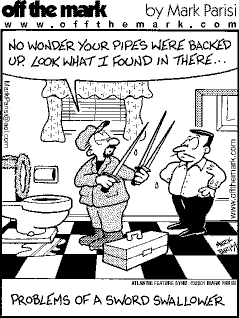
My wife sent me an e-mail today, something along the lines of:
the toilet is now unblocked!
I won't give you any more details ....
Brilliant!
Needless to say part of me wants to find out what happened (and hopes that she'll say that she flushed it and it was ok) while another part of me is scared in case she says something else (involving rolling her shirt up to her elbow)
I did what all men would do. I went in and flushed it. Why? I mean it's not like she would make that up.
Monday, April 24, 2006
The toilet is blocked

Yuk. The downstairs toilet is blocked. When it is flushed the water comes right up to the top in that ominous kind of way. Then it takes ages to drain away.
I searched tonight on the web for some clever solutions and found two sober facts.
Fact 1. The source of the blockage is probably something shoved into the toilet. Main culprit? 18 month old curly-haired tearaway male. I suspect a hairbrush, matchbox car or toilet roll was unceremoniously dumped in there.
Fact 2. The best way to unblock the toilet is the old-fashioned way. Indeed. Apparently you can buy special rubber gloves that go right up to your elbow. Yes, you get the picture.
I can tell you the weekend can not come soon enough. Yeuuuuch. Can you sense my excitement and anticipation?
Saturday, April 22, 2006
What happened to the wise old man?
I have a theory about wisdom. It suggests that wisdom is not just about age, it's about place and space.
So what am I talking about?
Well it's a given that if you've lived a long time and seen lots of things in your life then you'll have a perspective worth listening to. This is only part of the story though.
The bigger part is the bit around how you reason your way through what you have seen over the course of your life. I recently read a brilliant article written by Chris Argyris 15 years ago called "teaching smart people to learn". The article is very interesting and the point that really stood out for me is about a common mistake we make about people and learning.
Ask any professional educator how to ensure that successful learning takes place and they will tell you that it all begins with successful needs analysis. In other words if I'm going to teach a class to you and really want it to be a successful learning experience for you, I need to meet with you beforehand to work out what you want from the class. This is step 1 of the learning cycle and is fundamental for almost any teacher, trainer, instructor, presenter and so forth.
In other words by matching the content of the class to the needs of the participant learning can take place. Bingo!
This is where the mistake is happening, according to Argyris. We think learning happens because we understand the participant's motivation. If we can understand why they would want to learn then we can give it to them and make them learn. Argyris suggests this is plain wrong.
Instead he suggests that people don't learn because of the motivation from learning. Instead he says that people learn when they are able to successfully reason through what is being presented to them. In other words if people can interpret what is being said in the class, and can relate how this fits in their own personal space in the world, then they learn.
When I read this first I have to say that it was not so obvious. Now it is crystal clear.
Take a 4 year old child that has burned his fingers on a fire and ask him to do it again. He won't do it. His learning was not driven by motivation, but by his reasoning of what happened when he put his hands on the fire.
Let's get back to the original idea.
So take someone who has lived a long time, are they a wise man/woman? Could they be useful as a resource when you need to talk through a really tough problem? It depends.
It depends on how they have reasoned through what they have seen in their life. We've all met old men and old ladies who seem to have really figured out life, really understand people. We've all met old men and old ladies who don't have a clue about how life works and spend all day moaning about the government, the weather, other people, their feet and so on.
OK - two down and one to go. Still with me?
Wisdom requires some experience (you have to have lived a little) and reasoning (you have to be able to interpret what you see and hear and relate that to your life and to the wider context of the world.. what Peter Senge calls Systems Thinking). You've got to be able to see the connections between things, cause and effect, and how a little change in one place can affect things in a big way in another place.
To make the final leap to wisdom you need one final component (the last part of my theory). You need space.
Space means time to think and reflect, a few minutes in the day to ponder what just happened, or maybe what happened over the last few months or years. This is the really hard part.
Nowadays nobody seems to have any space, you know... time to think, to pause, to reflect. From the moment you wake your brain is in gear thinking about what needs to be done today. Off to work and on with the iPod and you're listening to music or an audiobook or podcast. Into work and you're reading your e-mail or sending an IM. Maybe the only time you have when you're free to think is when you're in the bathroom.
This is important. You need time to think, to pause, to reflect.
In those old western movies there was often a wise man in the clichéd native Indian village, sitting in the biggest Teepee tent. He was wise and sat there smoking a big pipe and not saying much. He was usually old. He was able to see things differently to the others in the group. He would speak slowly and deliberately, and use simple expressions.
Most cultures have this concept, often a magistrate or judge. Think about it. Older, a good listener, able to reason through a bunch of facts. Not reading his/her e-mail when he/she should be focused on what is going on around him/her.
So - to recap. To attain wisdom you just (1) stay alive for a good few years (2) develop good reasoning skills and see the connections between things so you understand why things happen and (3) give yourself time to do (2) by not filling up your every waking moment doing "stuff", especially time-wasting value-less stuff like watching reality TV.
That's my theory for today. Anyone disagree?
So what am I talking about?
Well it's a given that if you've lived a long time and seen lots of things in your life then you'll have a perspective worth listening to. This is only part of the story though.
The bigger part is the bit around how you reason your way through what you have seen over the course of your life. I recently read a brilliant article written by Chris Argyris 15 years ago called "teaching smart people to learn". The article is very interesting and the point that really stood out for me is about a common mistake we make about people and learning.
Ask any professional educator how to ensure that successful learning takes place and they will tell you that it all begins with successful needs analysis. In other words if I'm going to teach a class to you and really want it to be a successful learning experience for you, I need to meet with you beforehand to work out what you want from the class. This is step 1 of the learning cycle and is fundamental for almost any teacher, trainer, instructor, presenter and so forth.
In other words by matching the content of the class to the needs of the participant learning can take place. Bingo!
This is where the mistake is happening, according to Argyris. We think learning happens because we understand the participant's motivation. If we can understand why they would want to learn then we can give it to them and make them learn. Argyris suggests this is plain wrong.
Instead he suggests that people don't learn because of the motivation from learning. Instead he says that people learn when they are able to successfully reason through what is being presented to them. In other words if people can interpret what is being said in the class, and can relate how this fits in their own personal space in the world, then they learn.
When I read this first I have to say that it was not so obvious. Now it is crystal clear.
Take a 4 year old child that has burned his fingers on a fire and ask him to do it again. He won't do it. His learning was not driven by motivation, but by his reasoning of what happened when he put his hands on the fire.
Let's get back to the original idea.
So take someone who has lived a long time, are they a wise man/woman? Could they be useful as a resource when you need to talk through a really tough problem? It depends.
It depends on how they have reasoned through what they have seen in their life. We've all met old men and old ladies who seem to have really figured out life, really understand people. We've all met old men and old ladies who don't have a clue about how life works and spend all day moaning about the government, the weather, other people, their feet and so on.
OK - two down and one to go. Still with me?
Wisdom requires some experience (you have to have lived a little) and reasoning (you have to be able to interpret what you see and hear and relate that to your life and to the wider context of the world.. what Peter Senge calls Systems Thinking). You've got to be able to see the connections between things, cause and effect, and how a little change in one place can affect things in a big way in another place.
To make the final leap to wisdom you need one final component (the last part of my theory). You need space.
Space means time to think and reflect, a few minutes in the day to ponder what just happened, or maybe what happened over the last few months or years. This is the really hard part.
Nowadays nobody seems to have any space, you know... time to think, to pause, to reflect. From the moment you wake your brain is in gear thinking about what needs to be done today. Off to work and on with the iPod and you're listening to music or an audiobook or podcast. Into work and you're reading your e-mail or sending an IM. Maybe the only time you have when you're free to think is when you're in the bathroom.
This is important. You need time to think, to pause, to reflect.
In those old western movies there was often a wise man in the clichéd native Indian village, sitting in the biggest Teepee tent. He was wise and sat there smoking a big pipe and not saying much. He was usually old. He was able to see things differently to the others in the group. He would speak slowly and deliberately, and use simple expressions.
Most cultures have this concept, often a magistrate or judge. Think about it. Older, a good listener, able to reason through a bunch of facts. Not reading his/her e-mail when he/she should be focused on what is going on around him/her.
So - to recap. To attain wisdom you just (1) stay alive for a good few years (2) develop good reasoning skills and see the connections between things so you understand why things happen and (3) give yourself time to do (2) by not filling up your every waking moment doing "stuff", especially time-wasting value-less stuff like watching reality TV.
That's my theory for today. Anyone disagree?
Thursday, April 20, 2006
The search for focus
It's hard to stay focused on a single important goal sometimes.
Life is full of distractions, some interesting and some annoying.
I seem to veer from periods of extreme focus to periods of total anarchy. In recent weeks I've been back in the anarchy state, with loads of things starting to pile up and everything taking on significance and becoming a high priority.
So today I found myself focusing again on the single important goal. It's amazing how this sense of focus makes all the other stuff look like fluff.
I don't know how so many people go through life without any kind of goal at all. It saddens me to think about that. How many wasted hours people throw away doing nothing.
I'm being deliberately vague here.
If you've got a really big goal in life then good for you. If you haven't got one yet then think about the following:
It's 5 years from now and you're sitting in a beautiful room somewhere. Outside it's a beautiful day and the sun is shining brightly. You can see the expression on your own face, you have the biggest and most contented looking smile on your face that you've ever known. All around you are the people you really enjoy spending time with, and everyone is laughing and smiling and having fun.
take a piece of paper and a pen, any pen, and start writing a list. Start writing all the things you think are going on in your life at that "5-years from here" point. What have you achieved, what are you doing, where are you, who is with you, and so on.
Capture it - because it will reveal loads about where you really want to go, who you really want to be.
My image of this stage is very vivid and it drives me forward. How about you?
Life is full of distractions, some interesting and some annoying.
I seem to veer from periods of extreme focus to periods of total anarchy. In recent weeks I've been back in the anarchy state, with loads of things starting to pile up and everything taking on significance and becoming a high priority.
So today I found myself focusing again on the single important goal. It's amazing how this sense of focus makes all the other stuff look like fluff.
I don't know how so many people go through life without any kind of goal at all. It saddens me to think about that. How many wasted hours people throw away doing nothing.
I'm being deliberately vague here.
If you've got a really big goal in life then good for you. If you haven't got one yet then think about the following:
It's 5 years from now and you're sitting in a beautiful room somewhere. Outside it's a beautiful day and the sun is shining brightly. You can see the expression on your own face, you have the biggest and most contented looking smile on your face that you've ever known. All around you are the people you really enjoy spending time with, and everyone is laughing and smiling and having fun.
take a piece of paper and a pen, any pen, and start writing a list. Start writing all the things you think are going on in your life at that "5-years from here" point. What have you achieved, what are you doing, where are you, who is with you, and so on.
Capture it - because it will reveal loads about where you really want to go, who you really want to be.
My image of this stage is very vivid and it drives me forward. How about you?
Monday, April 17, 2006
What happened to plain speaking?

This week a leaflet was dropped in our letterbox advertising a fundraiser for Alzheimer's research. This is a good cause and something that deserves support.
Reading through it while eating breakfast today, now that I can eat normally again, I came across a line that struck me as daft and pretty-much meaningless.
"Our focus for raising funds..is reflective of our implementation of person-centred care models"
I took out the middle part of the sentence (it actually made sense in isolation) but the part above makes no sense to me.
I'd be interested in supporting this cause but have no clue what they are trying to say here. Is it important that they are implementing person-centred care models? What is a person-centred care model?
I imagine that this is really important stuff, seriously, but you have to help me out here when you send me stuff in the mail yet use language that only someone who understands this line of work can understand. This is industrial language, understandable only to those working in the particular field.
Surely there is a simpler way of saying what they want to say.
And then there is the cryptic meaning, when something is printed and you're not sure why they put it there.
My 4-year old got an Easter egg from his Grandmother, a Winnie the Pooh egg, and he was thrilled with it. On the back of the box there is a nice little section you can cut-out (with round-nose scissors) to make a little photo holder. Nice.
Then I saw this message from the manufacturer. It says:
"It is recommended that parents make a note of suppliers address for future reference"
So clearly I missed something. I'm expected to write to the supplier for some reason in the future. Not sure why.
Maybe they'd like some feedback in a couple of weeks, to tell them how the "How many Easter eggs did you get and what types?" conversation between the 4-year olds went when my son goes back to his Montessori next week.
Or maybe they'd like to know what the long-term impact of Trisodium Citrate has been on my son's behaviour. Maybe they expect a question from me clarifying how they computed the number of kiloJoules of energy on the nutrition information panel.
Why would I need their address. What future reference are they talking about?
Who is asking the hard questions around the boardroom table such as "why on earth would we put that on the box/leaflet/poster/receipt?". It sure as heck looks like nobody is asking so I have to read this cryptic and meaningless blather.
Help me out here with some plain speaking.
What kind of fool breaks a tree?
Driving from the house to the local mall today I am struck by how many recently-planted trees have been broken. I counted maybe 9 or 10 in a very small area and I am struck by the sheer pointlessness of this act of breaking young trees.
These trees have been planted in the last few months, in some cases in only the last month, and have been planted along the line of several recently completed new road projects.
They take the raw look off these new roads and new walls and will look really great when they mature in a couple of years.
That is the trees that are given a chance will look great. Those that lie snapped in half, lying on the roadside are finished.
To me this is really sad and the ultimate statement about something, but I'm just not sure what. I mean what kind of person sees a young tree and decides to break it.
Is it some kind of message to society? A reaction to someone feeling trapped by their situation and frustrated with the spending of money on these trees.. not likely in my view. Is it someone with a problem with nature? Equally unlikely I'd wager.
Could it be someone for whom the act of breaking a young tree represents a form of assertion of power? Tenuous I agree but for me this is possibly at the heart of it. A kind of "I break trees because I can" standpoint perhaps, but for me this is a real possibility.
If this is really true then this is really sad, lamentable and pathetic.
It would rank up there with people who feel some kind of gratification from breaking the glass in bus shelters, from spraying their name on a motorway bridge, from carving their initials on the desk in college, or from throwing trash on the street, just because they can.
I can't relate to this mindset, I really really can't.
This seems to close out the loop on the whole theory of broken windows that I have written about before.
If someone breaks a window and nobody fixes it, then quickly another window is broken and another until a bunch of windows are smashed. Ditto for trees so. A young tree is broken and not quickly replaced leading to another and another broken until a whole load of trees are snapped in half in senseless fashion.
The real question for me is whether people regret these acts later. I wrote along a similar vein a few posts back, about whether graffitists feel remorse. Same question here I guess, with maybe the same root motive about tree-breaking/graffiti-spraying.
Is tree-breaking where opportunity meets both stupidity and futility?
These trees have been planted in the last few months, in some cases in only the last month, and have been planted along the line of several recently completed new road projects.
They take the raw look off these new roads and new walls and will look really great when they mature in a couple of years.
That is the trees that are given a chance will look great. Those that lie snapped in half, lying on the roadside are finished.
To me this is really sad and the ultimate statement about something, but I'm just not sure what. I mean what kind of person sees a young tree and decides to break it.
Is it some kind of message to society? A reaction to someone feeling trapped by their situation and frustrated with the spending of money on these trees.. not likely in my view. Is it someone with a problem with nature? Equally unlikely I'd wager.
Could it be someone for whom the act of breaking a young tree represents a form of assertion of power? Tenuous I agree but for me this is possibly at the heart of it. A kind of "I break trees because I can" standpoint perhaps, but for me this is a real possibility.
If this is really true then this is really sad, lamentable and pathetic.
It would rank up there with people who feel some kind of gratification from breaking the glass in bus shelters, from spraying their name on a motorway bridge, from carving their initials on the desk in college, or from throwing trash on the street, just because they can.
I can't relate to this mindset, I really really can't.
This seems to close out the loop on the whole theory of broken windows that I have written about before.
If someone breaks a window and nobody fixes it, then quickly another window is broken and another until a bunch of windows are smashed. Ditto for trees so. A young tree is broken and not quickly replaced leading to another and another broken until a whole load of trees are snapped in half in senseless fashion.
The real question for me is whether people regret these acts later. I wrote along a similar vein a few posts back, about whether graffitists feel remorse. Same question here I guess, with maybe the same root motive about tree-breaking/graffiti-spraying.
Is tree-breaking where opportunity meets both stupidity and futility?
Sunday, April 16, 2006
Easter trots
 It's Easter morning and I have a dose of what my sister calls "the trots". This is her non-medical way of describing diarrhoea/diarrhea, especially strange given that she's a professional medic.
I can't understand why I have had such a run of bad health since the new year. I've had the winter vomiting bug, an upper-respiratory infection, headcolds and at least one other dose of "the trots" between here and last Christmas.
I guess my immunity system needs building up.
I took a load of anti-biotic pills, prescribed by the company doctor, for the chest infection and they did nothing for me. I'm beginning to think that I am immune to anti-biotics now. I was reading on a newsfeed yesterday that hospitals and doctors are being urged to stop prescribing anti-biotic pills for a whole array of ailments. It seems that these super-bugs are adapting to the workings of anti-biotics and have figured out how to stay present in the human body until the effects of the anti-biotics have waned.
This is a sobering thought. It seems that in our rush to the easiest solution for minor ailments we are creating a much more serious problem further down the line.
Anyway, enough about that.

This morning I set up the easter egg hunt around the house for the boys. It was a lot of fun watching the frantic search for chocolate eggs, culminating in a little stockpile on the sofa of chocolate treasures. A Mr. Men book was also included in the hunt, the aptly titled Mr. Greedy. It seems to have done the trick.
Now I am standing in the kitchen typing this, while a highly-dramatic scene from CHiPs is being re-enacted on the sofa using matchbox cars and toy motorcycles.
There is not much to do on Easter Sunday, except go to the relatives for dinner (if invited), or go to the big retail superstores to buy electrical appliances, gardening paraphenalia, or maybe some furniture. This year we have not been invited to my wife's parents' house for dinner. I think they need a break and it will be nice to give them a break from the mayhem. Not sure if I'll be eating anything later given my current state.
Next week will be an interesting week. It begins with a public holiday on Monday (so no work) and a 4-day work week containing 5 days' worth of work. This always happens.
It occurred to me that it has been maybe 2 years since I last watched a movie. Any movie. Anywhere. Even at home I have not sat down to watch a movie from start to finish. I think I'm beginning to miss being able to do that.
Wishing a wonderful Easter to anyone reading this.
Friday, April 14, 2006
Attribution error for sure
Yes. What a whopper. In my last posting I described the story of a NYC taxi driver who has a huge readership and who has recently earned a publishing deal.
In putting that posting together and forming my own view, I made what psychologists call a Fundamental Attribution Error (FAE). In brief I connected a couple of pieces of information together and arrived at a conclusion, a conclusion which was way off.
This taxi driver is a she and not a he, it's a lady who drives a taxi and likes to describe life in colourful language and a fair pile of swearing.
So, why did I trick myself into thinking this was a guy? First my brain made a connection between taxi drivers and males, I'm sure that connection was made in my head. Then there was the swearing. I mean swearing is something that is mostly connected with males. Now don't get me wrong, I know loads of women who swear like dockers, but for some reason my brain made that connection too. Going back to the blog in question tonight I'm guessing that my brain also made a connection between the site and the picture of the guy in the black hooded top.
I guess there's also the fact that I didn't go and check the profile of the blogger - it clearly says gender: female.. so I have only myself to blame for missing that.
Only that it was pointed out by Alan, I probably would never have noticed. This is really interesting to me that I did this, that I arrived at what I once heard described as "First conclusion bias". Alan knows more about this than many people I know because he is super-familiar with a famous case involving the Munich Philharmonic.
Many months ago I was discussing this implicit functional bias of our brains with some colleagues at work and found myself looking at the Harvard study on this. It's amazing what that particular study revealed, especially since most of us don't believe we have deep-rooted biases or unshakeable opinions about others we don't know when sadly it seems we do, whether we accept it or not. Worth checking out in my view, or maybe if you prefer a broader view of the idea you might want to get your hands on a copy of Blink by Malcolm Gladwell.
There's a blogging lesson for me.
Thanks to Alan for pointing it out, and to Cinthia for her comment and for the nice Easter wishes.
In putting that posting together and forming my own view, I made what psychologists call a Fundamental Attribution Error (FAE). In brief I connected a couple of pieces of information together and arrived at a conclusion, a conclusion which was way off.
This taxi driver is a she and not a he, it's a lady who drives a taxi and likes to describe life in colourful language and a fair pile of swearing.
So, why did I trick myself into thinking this was a guy? First my brain made a connection between taxi drivers and males, I'm sure that connection was made in my head. Then there was the swearing. I mean swearing is something that is mostly connected with males. Now don't get me wrong, I know loads of women who swear like dockers, but for some reason my brain made that connection too. Going back to the blog in question tonight I'm guessing that my brain also made a connection between the site and the picture of the guy in the black hooded top.
I guess there's also the fact that I didn't go and check the profile of the blogger - it clearly says gender: female.. so I have only myself to blame for missing that.
Only that it was pointed out by Alan, I probably would never have noticed. This is really interesting to me that I did this, that I arrived at what I once heard described as "First conclusion bias". Alan knows more about this than many people I know because he is super-familiar with a famous case involving the Munich Philharmonic.
Many months ago I was discussing this implicit functional bias of our brains with some colleagues at work and found myself looking at the Harvard study on this. It's amazing what that particular study revealed, especially since most of us don't believe we have deep-rooted biases or unshakeable opinions about others we don't know when sadly it seems we do, whether we accept it or not. Worth checking out in my view, or maybe if you prefer a broader view of the idea you might want to get your hands on a copy of Blink by Malcolm Gladwell.
There's a blogging lesson for me.
Thanks to Alan for pointing it out, and to Cinthia for her comment and for the nice Easter wishes.
Thursday, April 13, 2006
A blogging superstar
I have a tendency to browse through random blogs, looking for weird and interesting stuff but I can safely say that I rarely come across a blog that has huge readership, evidenced by hundreds of comments.
One that I came across earlier this week is New York Hack, a blog about a taxi driver in NYC who documents his days and takes snaps on his camera as he goes along.
One of his posts has a whopping 426 comments. Amazing.
He is pretty choice in his language though and doesn't hold back, so don't click if you are offended by swearing, more swearing and some pretty brash NY dialogue. Nothing you won't have heard if you watched Goodfellas though.
You'll see if you take a look at this blog that he has been offered a publishing deal. What an incredible story. The publisher in question is being pretty smart here, picking up on the obvious high levels of readship. If 426 people bothered to comment on one of his postings then how many just read it and moved on.
I know that most bloggers, me included, don't worry about who is reading their blog but you have to admit that this is really some impressive readership.
Sorry if this content offends you - but it does give you a pretty good sense of what life as a NYC taxi driver is like these days.
Wednesday, April 12, 2006
What happens when there's no water?

This week in work we have been experiencing something of a drought. Somebody seems to have broken a water main near the building and as a result on Tuesday and Wednesday some of the bathrooms were closed and the coffee counter was closed.
Today while I was sitting at the coffee area chatting with a colleague it occurred to me how we take the supply of water for granted. Sure we understand that if you want it in a fancy bottle shipped from a volcanic spring in France then you'll pay a premium. I saw a guy in the shop in work buying a bottle of water that was labelled something like "emotion" or some such nonsense. To make it worse it was infused with lemongrass. What the heck?
Then there's the stuff that comes out of the tap and we're all drinking that like it's going out of fashion.
So my mind got to wondering. All my recent research into Russian oil and gas led me to understand that many people, not just the Russians, are anxious about when the oil runs out.
What about if the water ever ran out? Ok so maybe the water won't ever run out but what if we keep polluting it and putting all kinds of toxins and dioxins in the land and the air that it intrinsically changes the nature of water, alters its pH and makes the stuff dangerous.
Wouldn't that be mad?
So at that stage you can take a shower but you'd better keep your mouth closed. Interesting.
Tuesday, April 11, 2006
The 7-minute fidgeting workout

Hilarious but true. Researchers appear to have some decent data on the value of doing tiny bits of exercise versus going to the gym and doing some hard exercise.
You can surely guess what they found. Yes, the small bits seem to have a better health benefit than sweating like mad at the gym.
In essence little things like parking your car a little further away than usual, or taking the stairs instead of the escalator, really adds up.
There's tons of little things that spring to mind.
I've never been a fan of gyms, the very idea of entering a warehouse-style building to go for a walk or run on a conveyor belt is off-the-scale ridiculous in my view.
So, let's hope this information makes it into the mainstream and people start to realise that the real key to health and fitness is to walk when you can and eat only what you need. They knew this stuff back when we were living in caves, yet again proving the old adage about the "value" of too much information.
Monday, April 10, 2006
Random acts of kindness
I'm never really sure what to think these days when people are nice to me. I'm talking about complete strangers. Last weekend there seemed to be a whole sequence of random acts of kindness happening to me, and to my family.
You could be forgiven for sometimes thinking that the whole planet has been overrun by narrow-minded and selfish people, intent on screwing the last penny out of you and making your life a living hell. There's plenty of that kind of incident around.
So, when people do stuff that is just plain kind and decent, even when it's something as simple as someone smiling at you in that really genuine way to appreciate your custom, well that startles me these days.
It's good to know that some people actually still like other people, even though they are strangers to each other.
You could be forgiven for sometimes thinking that the whole planet has been overrun by narrow-minded and selfish people, intent on screwing the last penny out of you and making your life a living hell. There's plenty of that kind of incident around.
So, when people do stuff that is just plain kind and decent, even when it's something as simple as someone smiling at you in that really genuine way to appreciate your custom, well that startles me these days.
It's good to know that some people actually still like other people, even though they are strangers to each other.
Monday, April 03, 2006
Everything comes to California

Not many people will have vivid recollections of an episode of CHiPs called "Finders Keepers". It aired on US television on the 29th November 1981, and can be seen on my television most Saturday mornings, courtesy of my nearly-four-year-old CHiPs-obsessed son.
Anyway, in this opening scene of the episode we see officer Jon Baker (call-sign "seven-mary-three") appear at the median of the highway as he spots his partner, Steve McCleish, parked at the side of the highway. Although Jon will be forever spoken about as part of a pair "Jon and Ponch", in fact in this fifth season he was partnered by Bruce Jenner because Ponch (Eric Estrada) had fallen out with the studio bosses and was now trying to inch his way back into the series. The studio had hired Bruce Jenner, a former Olympic Gold Medal-winning decathlete to take over from Estrada.
I digress. So Jon sees Steve at the side of the road and pulls over, after checking that it was safe to cross the centre dividing line. Jon parks and sees Steve squatting down examining the brush at the side of the highway. Jon sidles up beside him and asks him if everything is OK. Steve replies by saying that he's OK, but that he thought he saw something that doesn't belong there.
Jon asks what he means and he says "oh, you'll laugh if I tell you". He was right. He goes on to tell Jon that he thought he saw a wildflower, not native to these parts, and then spots it. He points it out and then berates Jon for attempting to pick it, telling him that it's a criminal offence to pick the flower. Jon laughs and says that he was only going to examine it. He reaches in and takes it in his hand and duly examines it.
Steve tells Jon that the flower is a Toadflax. Jon disagrees and says it's a Yellow Lupin. They can't agree and Steve says "either way it doesn't belong here". Jon smiles and says "eventually everything comes to California".
It strikes me some 15 years later that maybe the reverse is true. Maybe eventually everything that is in California arrives everywhere else.
Some examples:
McDonalds - is there anywhere that this company does not have a golden-arched outpost. Founded in San Bernardino, CA in 1940 and snapped up some time later by the entrepreneurial Ray Kroc.
Apple computer - almost a household name and at that point now where people are buying iPods without actually knowing what they are. Founded in Los Altos, CA in 1976. Everyone knows what happened to Jobs and Wozniak but what happened to Ronald Wayne?
"When Steve worked out 30 days credit on parts like chips, and we were able to build and deliver Apple I's and get paid in that 30 days, it was the start of things. But Ron was worried that some day we wouldn't get paid and would owe thousands of dollars on the parts. Steve and I had no money and Ron had gold hidden in his mattress (or some such thing) and they'd try to get it from him. So he sold out for $300 or $800 or some such amount."
OK maybe limiting the concept to California is not such a good idea. I hear people moaning about the homogenisation of shopping malls and city streets, the same logos and shop fronts now present in just about every city you can visit in Europe for sure. But so what? Wasn't this always going to be the outcome once word got out that country A has better-made Jeans that country B, or that country X has better coffee than country Y.
A kind of social osmosis where the best ideas diffuse my means of frequent travel and increased disposable income. It was always going to happen.
A whole new genre of nostalgia books has started to appear, longing for the old days and harking after old-fashioned values and the days when people used to doff their caps at one another.
It's over. Toadflax or Yellow Lupin. It doesn't matter. We love them all equally and welcome them to the edge of town.
Saturday, April 01, 2006
Remorse and graffitists

I was driving home along the motorway yesterday evening and noticed that the volume of graffiti is getting higher and higher. I feel personally connected with this problem, partly because I wrote to the county manager and suggested that there might be a more effective way to tackle the problem of graffiti.
He wrote back and passed me on to someone with specific responsibility for bridges and overpasses where most of this graffiti appears.
I gave him just enough information to make him curious yet he seemed to not want any more detail so I left him to it.
There was clear evidence that he was doing something different to address the problem for a few weeks but since then little has been done to address the problem and it's getting worse. The graffitists are winning the battle for now.
The idea of dealing with graffiti came from reading the book "The Tipping Point" but this was not the original source of the idea. The original idea came from a programme run by the State of New Jersey, the programme was known as the "Safe and Clean Neighborhoods Program".
A central part of the programme (I'll use the European spelling if you don't mind) involved putting a whole load of police officers back on "the beat", patrolling neighbourhoods on foot like in the old days. Now you can imagine that this went down like a lead balloon with the Police Department in New Jersey but grudgingly they agreed and went back on the beat.
The outcome of the programme was documented in "The Atlantic Monthly" in 1982 by two writers named George Kelling and James Wilson. The outcome was a surprise at the time, and continues to amaze people ever since.
In summary, just being there on the street, keeping an eye on things and physically demonstrating that law and order is present and enforced, the crime rate for petty crime plummeted. This had a knock-on effect on more serious crime. None of this was anticipated.
"Consider a building with a few broken windows. If the windows are not repaired, the tendency is for vandals to break a few more windows. Eventually, they may even break into the building, and if it's unoccupied, perhaps become squatters or light fires inside.
Or consider a sidewalk. Some litter accumulates. Soon, more litter accumulates. Eventually, people even start leaving bags of trash from take-out restaurants there or breaking into cars."
What has this got to do with the graffiti on the motorway. Well in The Tipping Point, Gladwell goes on to show that Kelling, a co-author of the aforementioned article, was hired as a consultant by the NY Transit authority and the first major problem he had to tackle was trash and graffiti. How did he resolve it? He attacked the problem when it was small.
This in essence is what I suggested should be done with the motorway bridges and overpasses. Why has it not worked? In true budget-obsessed fashion it seems some bright spark has decided it makes "economic sense" to wait until the graffiti has built-up to a significant level before sending out a cleaning/painting crew.
Clearly this is to miss the point. If you send the message that no matter how small a piece of graffiti is put on a wall, it won't be on the wall for longer than a single day. Eventually as graffitists get bored re-spraying the same thing over and over, they either move on (not likely since graffitists are opportunistic and not strategic - they are not actually marketing any real message) or they get bored and do something else.
I might pick this up again with the county manager, in the spirit of doing a good deed and maybe saving some time and effort if the problem is better understood.
All of this got me thinking about the concept of remorse among the graffitist community. I wonder has anyone ever gone home after a night of spraying graffiti, sat down on the edge of the bed and thought "what have I done?" More interesting is the question of whether anyone has ever gone back to the scene, climbed the fence, and proceded to spray over their graffiti tag with some nice bland grey paint?
Is there something in the genetic make-up of graffitists that inhibits remorse?
Subscribe to:
Posts (Atom)